


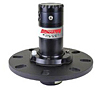
LL-100 Laser Level Transmitter
The LL-100 laser level measurement sensor is used for level control, plugged chute detection, and monitoring buildup. This non-contact device can be used in bulk solids, pellets, or granular materials of all material dielectrics in a variety of vessels. It measures in a tight 1° beam, so there is no beam divergence, making it suitable for use in very narrow vessels or constrained spaces. Narrow beam laser measurement technology is resistant to reliability issues caused by surface angle, slope, texture, granularity, or material color.
The laser level measurement sensor has a measuring range up to 160 feet and is highly accurate up to +/- 1 inch. It offers continuous level monitoring with a rapid update rate of eight times per second. The LL-100 can be aimed with great precision, making it suitable for vessels with interfering structure or with corrugation. It can also be applied in cramped, restrictive process equipment such as chutes or hoppers, or in confined equipment such as crushers. Laser is unaffected by heavy vapors and pressure making it very versatile across a wide variety of industries and materials.
Features:
• Adjustable mounting flange flexible up to 10 degrees
• Narrow beam can be directed to the output or bottom of the silo
• Easily configured in the field using a USB port
• Configuration can be performed without filling or emptying the silo
• Integrated dust protection for minimal maintenance
• Air purge option to keep lenses free of dust for reliable performance
Specifications:
• Range: 1 ft. to 160 ft. (.3m to 50m)
• Resolution: 10mm
• Accuracy: 1 standard deviation = 1 inch (2,5 cm)
• Update Rate: 8 readings per second
• Output: 4-20 mA NAMUR
• Filling Rate: 0,01 to 100m/min
• Power Supply: 24 VDC nominal (12-28 VDC)
• Communication: USB 115200 baud 8-N-1
• Operating Temperature: -4°F to 160°F (-20°C to 50°C)
• Electrical Connection: M16 x 1,5
• Enclosure Rating: IP66
• Air Purge: 1/8” BSP option
• Housing Material: Anodized aluminum
• Lens Material: Impact-resistant acrylic
• Beam Divergence to half power points: <1°
• Laser Safety Classification: Class 1M
• Caution: Don not view laser directly with optical instruments.
Applications:
• Level control, plugged chute detection, and monitoring buildup
• Measuring levels in narrow tanks containing bulk solids, pellets, or granular materials
• Opaque liquids in applications where the beam must be precisely targeted to avoid walls or structure

RL Acoustic Level Sensor
(3)The BinMaster RL is designed to provide highly reliable level data in challenging environments where dust levels are extremely high. The non-contact, continuous level sensor works in powders and solid materials of all types. Unlike some types of non-contact level sensors, the BinMaster RL can be used in very low dielectric materials which historically have not been compatible with non-contact devices. Although the RL looks just like the S, M and MV 3DLevelScanner, it is different because the purpose of the RL is level data only.
It performs better in dust compared to other technologies, such as ultrasonic. It uses acoustics-based technology at very low frequencies, which allows it to penetrate dust. Another unique quality of the BinMaster RL is that it is self-cleaning and requires very little maintenance unlike other non-contact technologies that require manual cleaning of the sensor which entails frequent climbing of silos, which can be a safety hazard.
The BinMaster RL is designed to be easy to program and simple to maintain. A “quick-start” guide allows the RL to be configured directly from a screen on the head of the device or alternatively, from a PC. The RL outputs a 4-20 analog signal for simple connection to an existing control system or display module.
This non-contact level sensor is an economical choice when non-contact technology is required to prevent contamination in environments such as food manufacturing, chemical and pharmaceutical processing. It is also ideal when any operation wants to eliminate the risk of a contact device that might break off and damage or get caught in equipment that might be present on the bottom of a silo, such as a sweep or conveyor.
Features:
• Dust-penetrating, non-contact technology
• Acoustics-based, continuous level indicator
• Works in powdered and solid materials
• Performs in low dielectric materials
• Self-cleaning, minimal-maintenance
• Economical and easy to use
• View data for all bins from a PC
• Daisy chain multiple silos to save money
• 4-20 analog output to control system or display module
Specifications:
• Housing & Antenna: Painted aluminum die casting
• Inspection Window in Housing: Polycarbonate
• Weight:12.35 lb. (5.6 Kg)
• Output Signal:Active 4-20 mA/HART/RS-485/Modbus
• Ambient, Storage, Transport and Process Temperature: 40 to +185˚F (-40 to 85˚C)
• Vessel Pressure: -2.9 to 43.5 PSI (-0.2-3 bar)
• Cable Entry/Plug: 1 x M20x1.5 (cable-Ø 8...12mm), 1 x blind stopper M20x1.5 or 2 x cable entry ½” NPT
• LCD Display Panel: 4 lines x 20 characters
• Adjustment Elements on Display Panel: 4 keys
• Supply Voltage: 18-32 VDC
• Power Consumption: Max 1.5 W at 24 VDC
• Electrical Protective Measures: IP67 according to IEC 60529
• CE EMC Emission: EN 61326:1997 (class B)
• CE EMC Susceptibility: IEC / EN 61326:1997 + A1:1998 + A2:2001 + A3:2003
• CE NSR (73/23/EWG): EN 61010-1:2001
• FCC Conformity: To part 15 of the FCC regulations FCC 47 CFR Part 15:2007, Subpart B, Class A
• Measurement Beam Angle: 15 degrees
• Frequency: 4.5 KHz
• Reaction / Settling Time: <5 seconds (dependent on the parameter adjustment)
Applications:
• Grain, Seed & Feed
• Ethanol & Bioenergy
• Chemical Processing
• Mining & Metals
• Food Processing
• Pulp, Paper & Wood Pellets
• Cement & Concrete
• Sand & Aggregates
• Plastics Manufacturing
• Coal Power Plants


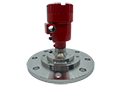

NCR-80 Non-Contact Radar for Solids (OBSOLETE)
THIS ITEM IS OBSOLETE AND HAS BEEN REPLACED WITH THE NCR-86
The BinMaster NCR-80 is a non-contact radar level sensor designed specifically for superior performance in powders and bulk solids. It uses a powerful 80 GHz frequency focused in a narrow 4° beam angle that allows for precise aiming to avoid the flow stream, internal structure, or sidewall buildup. This ensures reliable performance at measuring ranges up to 393 feet and accuracy within 0.2 inches. The NCR-80 is resistant to interference, while its advanced filters ensure rapid signal processing and an update rate of less than one second. Its advanced firmware constantly tracks echoes and automatically eliminates false echoes for reliable performance. The NCR-80 is ideal for continuous, single-point level measurement in tall and narrow vessels where there is excessive noise or dust.
There are two configurations of the NCR-80 and three different housing options including plastic, stainless, steel, or aluminum. One features a 10°swiveling, stainless steel flange for precise targeting at the material in the silo. The other mounts using a 8° swiveling flange or a mounting strap that allows for adjustable targeting and has a lightweight plastic antenna. The antenna lens is encased in a sealed antenna system. This makes it resistant to dust buildup and virtually maintenance free. The optional BinDisc interface installed within the housing offers simple push-button sensor setup and configuration. Once configured, data can also be sent to a PLC in a control system.
/Asset/BinMaster NCR-80.jpg